
Product Design & Development
Bringing a plastic product to market requires more than a good idea — it requires a design that is simultaneously functional, manufacturable, and cost-optimised for the chosen process. Our English-speaking engineering team provides end-to-end product design and development services specifically oriented toward injection moulding and extrusion, from initial concept through to production-ready tooling.
By integrating design and toolmaking under one roof, we eliminate the costly handoff errors that occur when a product designer and a toolmaker work at separate companies — and we do it at South African engineering rates that are 40–60% below comparable US or UK design firms.
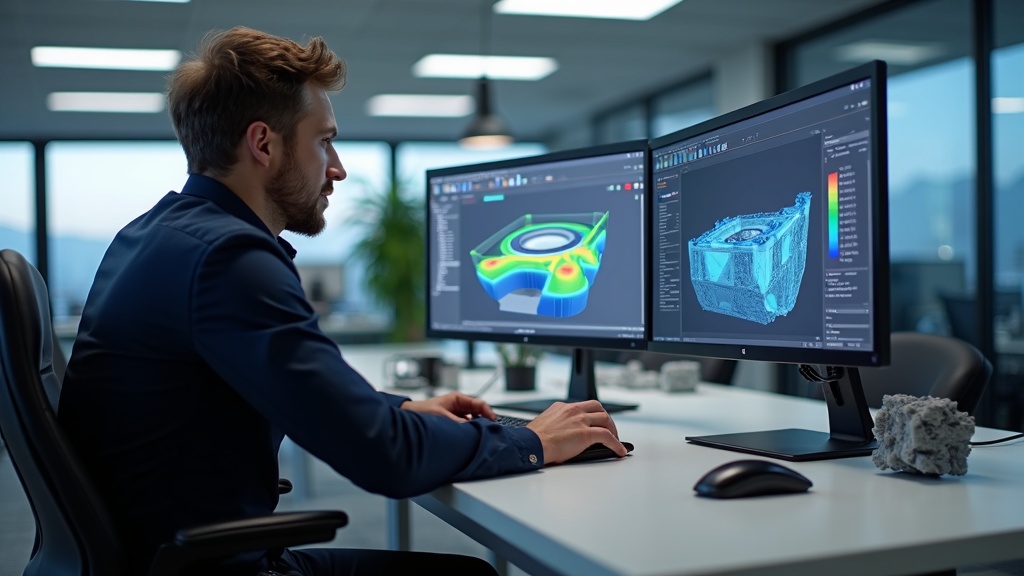
Engineering team reviewing 3D CAD and DFM analysis — Johannesburg, South Africa
The Design-to-Production Process
Every product design engagement follows a structured process that ensures the final design is fully validated before any tooling investment is committed.
- Concept Development: We work with your brief, sketches, or reference samples to define the product geometry, functional requirements, and target cost.
- Material Selection: We recommend the optimal plastic or polymer based on mechanical performance, chemical resistance, regulatory requirements, and cost. See our materials library.
- 3D CAD Modelling: Full parametric 3D model developed in SolidWorks, with assembly modelling where multiple components are involved.
- DFM Review: Formal Design for Manufacturability review identifying draft angles, wall thickness, undercuts, gate locations, and weld line risks before tooling begins.
- Mould Flow Analysis: Simulation of plastic fill, pack, cool, and warp to predict and eliminate cosmetic and dimensional issues. See our Mould Flow & DFM guide.
- Prototype: 3D-printed or soft-tool prototype for functional and aesthetic validation. Iterations are made at this stage — not after production tooling is cut.
- Tooling Design & Manufacture: Approved part design handed directly to our toolmaking team for mould design and machining. See our Mould & Tool Making page.
- First Article & Production Release: First-off parts inspected against the approved drawing. Process parameters documented and locked for production.
Design for Manufacturability: Key Principles
DFM for injection moulding is a discipline in itself. The following table summarises the most common design issues we identify and resolve during the DFM review phase.
| Design Issue | Risk if Unresolved | DFM Solution |
|---|---|---|
| Insufficient draft angle | Part sticks in mould; drag marks on surface | Minimum 1° draft on all vertical faces; 3° on textured surfaces |
| Non-uniform wall thickness | Sink marks, warpage, differential shrinkage | Target 2–4 mm uniform wall; core out thick sections |
| Sharp internal corners | Stress concentration; part cracking under load | Minimum 0.5 mm internal radius on all corners |
| Undercuts without side actions | Part cannot be ejected from mould | Redesign to eliminate undercut, or add side action / lifter to tool |
| Poor gate location | Weld lines on cosmetic surfaces; short shots | Gate at thickest section; use mould flow to validate fill pattern |
Industries We Serve
- Medical & Healthcare: Precision-moulded components with strict dimensional tolerances and biocompatible material selection.
- Automotive: Structural and aesthetic interior and exterior plastic components designed for high-volume production.
- Consumer Electronics: Enclosures, bezels, and connector housings with tight cosmetic and dimensional requirements.
- Consumer Goods: Innovative, market-ready product designs for everyday use, optimised for cost-effective high-volume production.
- Construction: Durable profiles and structural components for demanding outdoor environments.
Turn Your Concept Into a Production-Ready Part
Whether you have a detailed CAD file or just a napkin sketch, our engineering team will take it from concept to first-article approval.
Start Your Design ProjectCalculate Your Manufacturing Cost Savings
Landed Cost Arbitrage Calculator
Compare standard US/UK manufacturing against our quality-assured South African facility.