
High-Density Polyethylene (HDPE) Injection Molding
High-Density Polyethylene is one of the most widely specified polymers in industrial and consumer manufacturing. As a leading high density polyethylene manufacturer and global custom molding company, our South African facility delivers precision HDPE injection molding at 40-55% below US and UK domestic pricing — with full material traceability and rigorous quality control.
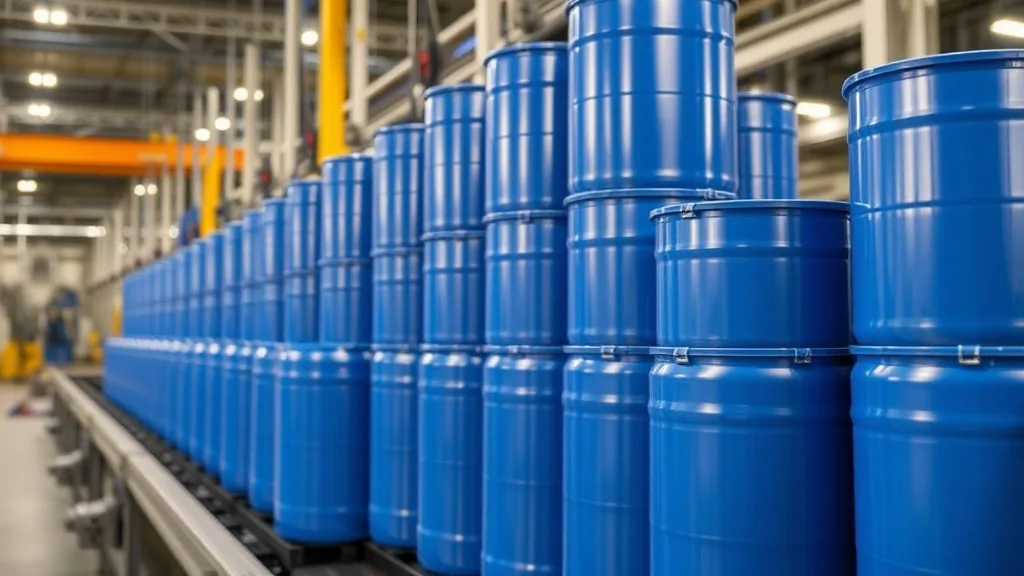
HDPE industrial packaging production line — Johannesburg, South Africa
HDPE Material Properties
HDPE (High-Density Polyethylene) is a semi-crystalline thermoplastic with a high strength-to-density ratio. Its molecular structure gives it excellent chemical resistance, low moisture absorption, and outstanding impact strength at low temperatures — making it the preferred choice for applications where ABS or Polypropylene would fail.
| Property | HDPE Value | Test Standard |
|---|---|---|
| Density | 0.941–0.965 g/cm³ | ASTM D792 |
| Tensile Strength | 22–31 MPa | ASTM D638 |
| Flexural Modulus | 800–1,400 MPa | ASTM D790 |
| Izod Impact (notched) | No break (at 23°C) | ASTM D256 |
| Mold Shrinkage | 1.5–3.0% | ASTM D955 |
| HDT at 0.45 MPa | 60–82°C | ASTM D648 |
Managing HDPE Shrinkage Rates in Mold Design
HDPE's semi-crystalline structure produces one of the highest and most anisotropic shrinkage rates of any commodity thermoplastic — typically 1.5% to 3.0% in the flow direction and 1.0% to 2.0% transverse to flow. This directional differential is the primary engineering challenge in HDPE mold design and is the leading cause of warpage in improperly designed tools.
Our mold design engineers address HDPE shrinkage through three primary strategies. First, cavity compensation: all cavity dimensions are machined to a calculated compensated size based on the specific HDPE grade's published shrinkage data and the part's wall thickness profile. For a nominal 3mm wall section, we apply a 2.2% linear compensation as a baseline, then refine through mold trials. Second, gate optimization: fan gates and film gates are preferred over point gates for flat HDPE parts to minimize differential shrinkage between flow and transverse directions. Third, cooling channel engineering: uniform cooling is critical for HDPE. Our mold designers use Moldflow simulation to verify that the temperature differential between the hottest and coolest point of the cavity does not exceed 8°C, as temperature gradients above this threshold create differential crystallization rates that cause post-mold warpage.
UV Stabilization for Agricultural Parts
Unstabilized HDPE undergoes rapid photo-oxidative degradation when exposed to outdoor UV radiation. Within 6-12 months of outdoor exposure, unstabilized HDPE exhibits surface chalking, embrittlement, and a 40-60% reduction in impact strength. For agricultural applications — irrigation fittings, livestock water troughs, crop crates, and greenhouse components — UV stabilization is not optional; it is a fundamental material specification.
We incorporate HALS (Hindered Amine Light Stabilizer) masterbatches at 0.5-1.5% loading levels, compounded directly into the HDPE melt during the molding process. HALS-stabilized HDPE retains over 80% of its original tensile strength after 5,000 hours of accelerated UV exposure per ASTM G154 (UV-A 340nm lamp), equivalent to approximately 10-15 years of outdoor service in a high-UV environment such as Southern Africa or the US Southwest. For black agricultural components, carbon black at 2.0-2.5% loading provides both UV protection and additional thermal stabilization.
HDPE vs. Polypropylene: Cost and Performance Analysis
HDPE and Polypropylene (PP) are the two most widely used commodity thermoplastics globally, and they are frequently compared in material selection reviews. While their commodity pricing is similar (typically within 5-10% per kilogram), their performance profiles diverge significantly in several critical areas.
Impact resistance at low temperatures: HDPE maintains excellent impact strength down to -40°C, making it the preferred choice for cold-chain packaging, refrigerated storage containers, and outdoor agricultural equipment in cold climates. PP becomes brittle below -10°C and is not recommended for applications exposed to freezing temperatures without impact modifier additives.
Chemical resistance: Both HDPE and PP offer excellent resistance to dilute acids, bases, and alcohols. However, HDPE provides superior resistance to concentrated acids and oxidizing agents, making it the preferred choice for chemical storage containers and industrial fluid handling components.
Stiffness and heat resistance: PP offers a higher flexural modulus (1,300-1,800 MPa vs. HDPE's 800-1,400 MPa) and a higher heat deflection temperature (100-115°C vs. HDPE's 60-82°C at 0.45 MPa). For applications requiring dimensional stability at elevated temperatures — automotive under-hood components, dishwasher-safe containers, and hot-fill packaging — PP is the technically superior choice.
Our DFM engineers will review your application requirements and recommend the optimal resin before any tooling commitment is made. In many cases, a hybrid approach — HDPE for the structural body and PP for snap-fit features — delivers the best overall performance at the lowest total system cost.
Typical HDPE Applications
- Industrial Packaging: Drums, IBCs, jerricans, and chemical storage containers.
- Agricultural Components: Irrigation fittings, crop crates, water troughs, and greenhouse fittings.
- Consumer Products: Cutting boards, food storage containers, and outdoor furniture.
- Pipe & Fittings: Water supply, gas distribution, and industrial fluid handling.
Calculate Your HDPE Margin Improvement
Select HDPE and your target volume to see the exact landed cost comparison.
Landed Cost Arbitrage Calculator
Compare standard US/UK manufacturing against our quality-assured South African facility.