
Precision CNC Machining Services
Not every component justifies a full injection mold investment. Our CNC machining services, delivered through our global custom molding company network, bridge the gap between prototyping and high-volume production — delivering tight-tolerance metal and plastic parts directly from our ISO-certified South African facility at 40-55% below US and UK machine-shop rates.
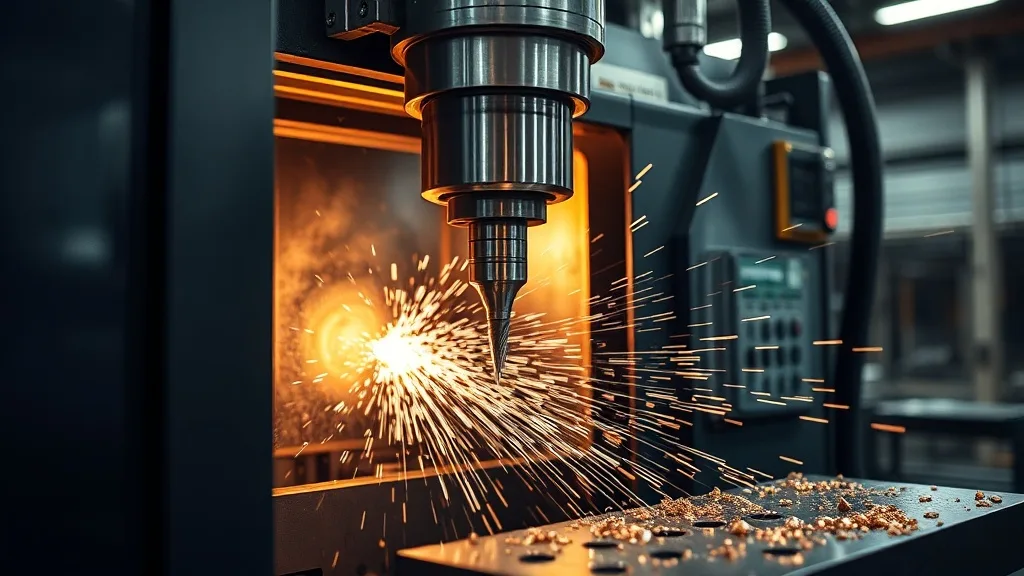
5-axis CNC milling centre cutting P20 tool steel — Sandton, South Africa
Capabilities & Equipment
Our facility operates multi-axis CNC milling centres, precision CNC lathes, and wire EDM machines — the same equipment used to cut the P20 and H13 steel molds for our injection molding division. This integrated setup means your CNC-machined prototype can transition directly into tooling production without re-quoting or re-qualifying a new supplier.
- 3-Axis & 4-Axis CNC Milling: Complex geometries, pockets, and contoured surfaces in steel, aluminium, and engineering plastics.
- CNC Turning: Rotational components, threaded inserts, and custom fasteners to ±0.01mm.
- Wire EDM: Intricate internal profiles and hardened tool steel inserts that cannot be conventionally machined.
- Surface Grinding: Flat and parallel surfaces to mirror-finish quality for mold parting lines and sealing faces.
Spindle Speeds, Tolerance Limits & Surface Finish
Our CNC milling centres operate at spindle speeds up to 20,000 RPM, enabling high-speed machining (HSM) strategies that reduce cycle times by 30-50% compared to conventional cutting parameters. For hardened H13 tool steel (44-52 HRC), we utilize solid carbide end mills with TiAlN coatings, maintaining chip loads of 0.02-0.05mm per tooth to achieve surface roughness values of Ra 0.4-0.8μm without secondary polishing operations.
Dimensional tolerance capabilities by operation type are as follows: CNC milling holds ±0.025mm on general features and ±0.010mm on critical bore and shaft fits; CNC turning achieves ±0.010mm on diameter and ±0.015mm on length; wire EDM achieves ±0.005mm on profile, making it the preferred process for punch-and-die sets and precision mold inserts. All critical dimensions are verified on our Zeiss CMM (Coordinate Measuring Machine) with full dimensional reports provided as standard.
5-Axis vs. 3-Axis CNC: ROI Analysis
The decision between 3-axis and 5-axis machining is primarily an economic one. For prismatic parts with features accessible from three orthogonal directions, 3-axis machining is the most cost-effective approach. However, for complex sculptured surfaces — such as injection mold cavities with undercuts, turbine blades, or orthopaedic implant geometries — 5-axis simultaneous machining delivers a compelling ROI through three mechanisms.
First, 5-axis machining eliminates multiple setups. A part that requires four separate fixtures and setups on a 3-axis machine can often be completed in a single setup on a 5-axis centre, reducing fixturing time by 60-80% and eliminating datum transfer errors between setups. Second, shorter cutting tools can be used because the spindle tilts to maintain optimal tool engagement, reducing tool deflection and improving surface finish. Third, complex cavities that would require EDM finishing after 3-axis milling can often be completed entirely by 5-axis cutting, removing an entire process step from the workflow.
For injection mold tooling specifically, we recommend 5-axis machining for all cavities with draft angles below 1.5°, any core/cavity split requiring compound parting surfaces, and all molds with lifter or side-action geometry. The additional machine-hour cost of 5-axis is consistently offset by reduced polishing time and improved first-shot dimensional accuracy.
CMM Inspection Processes
Quality assurance is not an afterthought; it is integrated into the machining process. Our Zeiss Coordinate Measuring Machine (CMM) is housed in a climate-controlled inspection lab maintained at 20°C ± 1°C.
For critical aerospace and medical components, we perform 100% inspection of critical-to-function (CTF) dimensions. The CMM probe maps the physical part geometry and compares it directly against the native CAD model, generating a comprehensive First Article Inspection (FAI) report that details nominal dimension, measured dimension, and deviation. This ensures that every part shipped meets the specified ISO 2768 tolerances.
Common Machined Polymers (PEEK, Delrin, PTFE)
While we machine extensive volumes of aluminium and steel, our expertise extends deeply into engineering polymers. Machining plastics requires entirely different feeds, speeds, and tooling geometries than metals to prevent melting, smearing, and excessive tool wear.
PEEK (Polyetheretherketone): A high-performance semi-crystalline thermoplastic with exceptional mechanical properties and chemical resistance. Machining PEEK requires sharp, positive-rake carbide tooling and aggressive coolant flow to manage heat generation. It is frequently used for medical implants and aerospace components.
Delrin (Acetal / POM): Highly machinable, Delrin offers excellent dimensional stability and low friction. It is the material of choice for precision gears, bearings, and structural components. We utilize high spindle speeds and moderate feed rates to achieve mirror-like surface finishes on Delrin parts.
PTFE (Teflon): Extremely soft and prone to deformation during machining. Holding tight tolerances on PTFE requires specialized workholding techniques and extremely sharp tooling to slice the material rather than push it. It is specified for chemical seals, gaskets, and low-friction wear pads.
Surface Finishing & Anodizing
Post-machining surface finishing is a critical quality gate that determines the cosmetic and functional performance of the final part. Our facility offers a complete range of finishing operations in-house, eliminating the need for external sub-contractors and reducing lead time by 3-5 days.
- Manual & Robotic Polishing: SPI A1 (Ra 0.012μm) through SPI D3 (Ra 3.2μm) mold surface finishes for injection tooling.
- Hard Anodizing (Type III): 25-50μm aluminium oxide layer for aluminium prototype tooling and structural components, providing hardness equivalent to mild steel.
- Electroless Nickel Plating: Uniform 25μm coating for corrosion resistance on mold cores and cavities processing aggressive resins.
- Bead Blasting & Texture: Matte and textured finishes for consumer product aesthetics, matched to Mold-Tech texture standards.
Compare Your Machining Costs
Use the calculator below to see how offshore manufacturing affects your total landed cost.
Landed Cost Arbitrage Calculator
Compare standard US/UK manufacturing against our South African ISO-certified facility.